Showing posts with label Equipment. Show all posts

Sunday, May 10, 2009

Stuff we're excited about...

New Leaders:
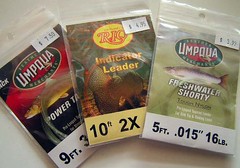
We're carrying some great new leaders for 2009. The Rio Indicator Leaders have been flying off the rack. These are straight leaders, which are much more accurate and effective for deep nymphing ion the 'Mo. The are 10' in length, with a 2 foot butt section tapered to 8 feet of tippet. Easily cut back to whatever length yu desire. The Freshwater Shorty from Umpqua is the leader to use with sink tips. 5 ft. and comes in 8, 10, 12 and 16 lb. For floating line streamer fishing, the RioMax Leader is the choice. 10 ft. and comes in 8, 10, 12 and 15 lb. strengths. Umpqua has the Power Taper Leader, which we prefer for throwing medium to large dries in the wind. The long butt section transfers energy very efficiently. Don't forget how inportant your leader is to your fishing system!

Headhunters Logowear:
The 2009 Headhunters Logo stuff is in, and more is on the way. All the cool kids are wearing it. We've got a whole new selection of caps, knit beanies, t-shirts, Simms fishing shirts, hoodies, and other "must have" stuff. Top sellers have been the Simms Softshell Windstopper jacket, Bottlecap T's, and of course, our large selction of headwear. Don't forget about free Headhunters Stickers.

Costa Del Mar:
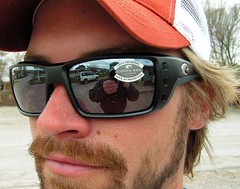
Costa has some very hip new frames out for 2009. We forecast the Permit will be the new hot frame. The Lee Wulff meets Gangsta look is very cool, and provides maximum protection from the sun and you buddies crazy casts and hook sets. The Harpoon remains our top seller...just ask your guide. All Costas are available in any frame lens combination.

Dr Slick Split Shot Pliers:
With the help of our buddy Tim Tollet (Frontier Anglers, Dillon), the good doctor has developed these great hemo-style clamps that hold split shot. They also have a blade fro removing any size shot from you leader. Mandatory for tailwater nymphers...

Echo Gecko:
The ultimate childrens fly rod (but could be fun for adult as well). I won't try to describe it...you just gotta come in and see it.

More coming...

Saturday, May 2, 2009

Get your Yeti?

Now that the staff of Headhunters has sobered up from the snow parties that thankfully ended with the snow melt...we need to keep our adult beverages cold for the impending summer temperatures. This cooler on the right, the Yeti Tundra Series is THE ANSWER! Not only does it look cool, it keeps your beer cool too.

Yeti’s next generation cooler. Over 2” of insulation in both the body and lid are combined with a freezer-quality seal to create optimal ice-retention. The Roto-molded one-piece casing withstands high-impact use and harsh environments. Innovative features include integrated, heavy-duty T-Latches and molded-in, self-stopping hinges. In addition, incorporated rope-handles, non-slip/non-marking feet, and recessed leak-proof drain plugs are also Yeti original design.

The Yeti seems to be the best Ice Box on the market...and they are proud of them. This is not your father's ice chest. For serious guides only!

Headhunters Fly Shop and Guide Service now carries the Yeti line for those of you who need and deserve the best. Goes hand in hand with your local the quality of your local information, education, and customer service leader.

We have the Tundra Series in 35 qt. and 45 qt. Perfect for the boat, back of the truck, or porch. If you really want to impress your friends and throw a kick-ass BBQ on the porch...go big and get the 120 qt.

The Roadie Series in 15 qt. & 25 qt. are in the store...ideal for keeping cold ones in your SUV for chugging after a great day on the Mo.

The Roughneck Series in 25 qt. & 40 qt., which is a touch less expensive...perfect for your wife's sister's husband. He will appreciate the gift, and then become envious of your cooler looking cooler!

Get on board, be the first on your block to own a Yeti.

A couple links to look at and drool...Yeti Website or check out the Yeti Blog and learn how to make your Yeti perform like a champion.

Fly of the Week: It's anybody's guess...how about a Leadwing Coachman...swing it.

Guide Bitch of the Week: Low Holing...you dirty bastards...just don't do it. C'Mon?!!

Capt. Carp's Dead song of the Day: Beat it on down the line

Word of the Day: Nefarious...used in a conversation about his fishing buddy.

Sunday, April 26, 2009

Sol Sungard

Sol Sungard products are arguably the finest sunscreen products on the market. The best thing about this sunscreen is that when it does come in contact with your eyes...they do not water. It is totally safe for ramming into your eyes. If you don't believe me, next time you are in the shop, I will dump some into my own eyes.

I often have clients on the river that have been afflicted by the ol' sunscreen in the eyes syndrome. It does suck. My theory is if you do not want sunscreen in your eyes, don't put it into your eyes. It is kind of an intelligence test...you decide if you will pass or not. If you have a hat on, you do not need to protect your forehead. Think about it.

Sol's Bluewater ultra low chemical-active formula uses Z-Cote, a powerful, microfine zinc oxide that offers transparent and total protection against both UVA and UVB rays. Its unique fragrance-free, emulsion-loc technology means the sunscreen stays on your skin and out of your eyes..but it does not matter!! Skin protecting emollients protect your skin from drying, chapping and irritation. Get some sun, but first get some Sol. Extra gentle, formulated for water sports.

It truly is a dynamite product. The lip balms are super as well. Easy to get on and protects all day. A couple of different flavors, my new fav is Citrus. It rules!

For more info about Sol Sungard Products, visit the Website.

Fly of the Week: Fire Bead Soft Hackle Ray Charles

Capt. Carp Dead Song of the Day: Terrapin Station

Quirky Guide Behavior of the Week: A guide we know, if the fly is not working, even if it is a size 18 PT, he will clip the fly off, break off the hook, and chuck it into the water. That's Quirky.

Sunday, April 5, 2009

George Harvey Slackline Leader

I've been using the Harvey Slackline for going on 15 years and still love it. Are there better leaders for dry fly fishing? Maybe...it is all conjecture and personal opinion. The beauty of a Slackline is that it turns over, and leaves the last 25% of leader, the tippet, slack so you can achieve the proper drift for the sometimes difficult fish that inhabit the Missouri.

It starts with Maxima Chameleon which allows for a good turnover of the leader, and depending on which mono materials you prefer can continue with Max until the tippet portion. All the old schoolers like Max, still popular with the steelhead gang too, and especially if you are from the East Coast. Another benefit of hand tied leaders is that you can truly design a leader to do exactly what you want. Sometimes store bought machine tapered leaders will "kick" in a direction that you do not desire. I'm sure you have encountered this. If you are casting downstream at a giant rising brown...and as the leader unfolds, the fly "kicks" upstream. That is enough to drive a guy to drink! You may only have one shot at a fish like that. So, you really need a leader that does the right thing in this situation. That is where a hand built leader like the Harvey is clutch. I always tie these with Blood Knots, mainly because it is nice looking, I don't believe in the Surgeon's Knot...but that is neither here nor there.

Here is the Harvey Slackline All Around 10' Formula:
I start with a larger diameter butt section Chameleon Max .022"-.024" with a loop to loop, or not. Then tie on:
10" .017 Maxima Chameleon
20" .015 Maxima Chameleon
20" .013 Maxima Chameleon
20" .011 (0X) Maxima Clear
12" .009 (2X) Rio Flouroflex Plus
10" .007 (4X) Rio Flouroflex Plus
28" .006 (5X) Rio Suppleflex Mono

This leader starts with stiff Max Mono/brown, tapers to Max Mono/Clear, Flourocarbon, and finally to soft/limp mono. A damn good dry fly leader. I generally cast down and across to rising fish, and this works well for myself and my clients. It unfolds straight, and drops to the water with slack built in. Most guides have their own dry fly leader formula, and there is commonly arguments about leader design on the porch at night...this is just my favorite.

There are a ton of leader designs that are effective. Check out the Leader Formula Bonanza http://www.flyfisherman.com/skills/50formulas.pdf

Tuesday, March 31, 2009

The Straight Nymph Leader

For many nymph fishermen, straight leaders provide an efficient, accurate and economical leader system. Straight (non-tapered) leaders are not new nor are they a secret. There have been many articles describing their use and advantages over the last 10 years. Scumliner himself swears by straight nymphing leaders, and if you have fished with him, you have seen him casually clip off your brand new $4 tapered leader and replace it with one of his custom built Bimini nymph leaders (you have no choice). Let go into some of the why's and how's of the straight leader system.

Advantages:
The straight leader system offers several advantages, but the primary one is that you can achieve quick, accurate and maximum depth. Tapered leaders prevent a straight, 90 degree drop from your indicator (or fly line tip for you Czech Nympher's). This is due to the heavy "butt" section built into the leader, which causes far more drag than a straight system. The amount of drag will vary depending on the the length, weight and type of leader you use. Regardless, your leader will arc to some degree, unless you are using a massive amount of weight at the terminal end.

You can also use less weight to achieve the same depth more quickly. Because drag is significantly reduced, your flies reach their max depth almost immediately. I've always preferred to use less weight and a slightly longer leader if possible. It makes casting easier, and I feel my drift is more natural, and takes are more easily detected.

Straight leaders are much easier to lengthen or shorten if needed. Many anglers choose to move their indicator instead of lengthening the leader. When I decide to change length, however, I usually make a dramatic change. On the Missouri, we're fishing big water with a great variety of depth. If I'm not getting fish at 4 feet, I don't go to 5...I go to 7. Because my leader is uniform, it's easy to add or remove a couple of feet. I don't have to worry about drastic changes in tippet/leader diameter; it's a constant.

Disadvantages:
Casting with a straight leader, while not as difficult as some would have you believe, can be a bit clumsy. Ease of casting is dictated almost entirely by the weight at the terminal end; the more the better. If you have 2 BB's and a tungsten Beadhead fly, you won't have any trouble. On the other hand, unweighted or lightly weighted rigs can be very difficult to cast on a straight system. All of the energy in your line is lost the second it reaches your non-tapered leader.

On the Missouri we do a lot of shallow nymphing, usually involving rigs with small beadhead nymphs, no weight and a very small indicator placed 2 - 4 feet above the top fly. The fly is fished only an inch or two under the surface. I like to use a 9 foot leader for this, as the fish are usually sensitive to lines and mending. Trying to cast a 9 foot straight leader with no weight is tough enough. When you add the small, but still wind resistant, indicator on the end, and it's nearly impossible for many anglers.

Aside from casting, the only other disadvantage of a straight leader is the weak point created by connecting a 20-30lb. butt section to 2X-4X leader material. There are many knots used to do this, including a perfection loop to loop, albright, a scary looking triple surgeons, and a clinch to a loop connection. I've tried them all and always had the occasional (or not so accasional) break at the knot, resulting in not only lost flies, but the entire leader. I have come up with a solution, which is described below.

By the way, never attach a knot secured indicator to a straight leader, always attach it to the butt section. Stick-on Palsa type indicators can of course be used anywhere on the leader.

Building Straight Leaders:
For years I've been building straight nymphing leaders...I had to, you couldn't buy them. Fortunately, RIO has just come out with a straight nymph "indicator" leader. So far, I've been very happy with these, and they will probably replace my own version at some point soon.

For those interested in my own system, here it is:

This is a three part leader and uses loop-to-loop systems. The butt section consists of 30lb. hi-vis mono. It is 1 foot long with perfection loops at each end. Most anglers have a butt section on the end of their line, but I like to add this so that if I'm tying an indicator on the leader, I don't 'kink' my butt section...the kink remains in the nymph butt section.

For the leader itself, I use 10 lb followed by 8 lb mono or flourocarbon, usually something from the tackle section at the sporting goods store (I like Yozuri Hybrid). Start with 6 feet of 10 pound. In one end, tie a short (1 foot) bimini twist loop. I then hold the knot in my left hand, and stick my finger in the loop. twist the loop until it is always almost tight around your finger. Holding it tight, grab the twisted loop in the center with your mouth and pull towards you. Let your fingers come together. The Loop will twist up on itself. I then tie a simple surgeons knot in the twisted section, right above the bimini knot. Trim the tag of the surgeons loop.

You should end up with a 6 inch twisted loop, followed by your bimini twist, followed by about 4 feet of 10 lb. This creates a very strong, doubled loop at the end. The twisted loop creates a "shock absorber" effect as well. I have never had this knot fail, nor have I experienced a break at the loop to loop connection.

To finish your leader, loop the butt section to the twisted loop. Make your 10 lb section (including bimini loop) about 3 feet (less if you plan on nymphing shallow). Add 6 or more feet of 8 lb to the 10 lb. Thats it. When you're ready to fish, cut the leader to the depth you want your first fly or weight at. Then add the appropriate amount and size of tippet...
Tuesday, March 24, 2009

From the Reel to the Fly

Over the next couple of weeks, we'll be posting some articles about leaders and materials, leader construction, and fly lines...the things that deliver your fly to the fish. Without them, fly rods would be called spinning rods. Improperly built leaders can defeat all attempts to make a good cast and presentation. Fly lines that are worn out, not balanced for your rod, or are the wrong taper for the situation make casting and mending a chore. Using cheap, rotten or the wrong size tippet can be the difference between hooking and actually catching a trout.

These are all issues that we see, both in the shop and on the river, all too often during the season. Hopefully we can teach you a thing or two, and remind you how important your line and terminal tackle is to your success.

Squeeky and Scumliner will be sharing their knowledge and opinions, so stay tuned. There should be some humor involved as well...

Sunday, February 8, 2009

What in the heck is a Switch Rod?


Echo Switch Rod
2009 will not be remembered as the year lots of new and exciting ideas hit the fly fishing market. When Mark and I attended the Fly Fishing Retailer show in Denver last fall, we found very few new and original products. You know, those "life altering" items like the buff, thingamabobber, gore-tex waders, zingers, graphite rods, and if you go way back, floating lines. Rod manufacturers didn't offer many new models or improvements either, but nearly every one of them had a new line of switch rods. For 2009, Headhunters will be carrying models by both G Loomis (by far the best and most expensive) and Echo (great price). Here's a little bit about them.

What is a switch rod? Well, it's kind of a cross between a modern two-handed (or spey) rod, and a traditional single handed fly rod. They are short enough to cast as a single handed rod (though they are a bit clumsy), and they have just enough length to execute several different spey casts. Nearly every model we saw was 11 feet, or within a couple inches of it. They have a handle similar to a two-handed rod, but in a smaller and shorter size. These are not lightweight two handed rods, which generally run around 12'6", and often have a traditional "spey" action which is too slow for accurate or powerful single-handed casting.

History

Switch rods really aren't new. I bought my first one in '98 or '99 (I can't remember). It was a new model from Scott, 11'3" 6 weight. The term "switch" didn't even exist. The guys from Scott described it as "a long single handed rod that we put this funny handle on so you can do some spey casting with it but we really like it for nymph fishing especially in pocket water but maybe not from a boat because it's so long it's hard to land a fish and it's a great streamer rod as well, especially if you're wade fishing and you might want to try it for light summer Steelhead on the Ronde and Fletcher White thinks it would make a great Bonefish rod too". In other words, they didn't really know what they had. Spey casting was getting popular,but nothing like in the last five years, so that element wasn't going to sell that many rods. Kudos to Scott, however, for being ten years ahead of the curve.

So why are they becoming popular now if they have been around for so long? Because while Scott (and a few others) had come up with a ground breaking idea, the line companies didn't have a line that worked very well on it. At the time, spey lines only went down to a 7/8/9 range, and really had too long of a belly for a 6 weight trout rod. This was back when Steelheaders were still doing proper spey casts with long belly fly lines (maybe I'll share that opinion at another time). Very few anglers were using anything short enough to use on an 11 foot rod. I tried a bunch of lines, and finally settled on a Rio Windcutter #7 line. It worked OK overhead casting, but I really couldn't do a very good spey cast with it. After a year, I decided the rod was just a novelty, and it spent most of it's life with me in the closet.

Fortunately, there were a small group of guys on the Skagit River that were hacking up lines and splicing them together to build custom spey lines for their Two handers. At the smae time, European anglers were developing their own shooting head systems. These eventually became known as "Skagit" and "Scandinavian" lines. Skagit (and Scandi) lines have a much shorter, heavier head than traditional spey lines. They are made for shooting line and turning over large, bulky flies. These lines are often used with a sink tip on the front. Because they have a shorter head, they work much better when spey casting with your switch rod. Last year, several line companies came out with "compact" Skagit and Scandinavian heads, which are even shorter. These are ideal lines for switch rods, and allow you to perform nearly any spey cast with your switch rod. They aren't perfect for single handed casting, but they finally give you a line that you can use for both situations.

Advantages and Disadvantages

Switch rods give you several advantages over traditional-single handers. They allow you to easily cast and mend tremendous amounts of line. You can also set the hook with as much as 50 (or more) feet of line out while nymphing. Once you learn a few spey casts, you will find that you have a whole new repertoire of casts that you can use when the wind is coming from the wrong direction or you have trees and shrubs immediately behind you (you can, by the way, make all of these casts with your 9 footer as well). High stick or Czech nymphing techniques are a breeze with these long rods. And anglers that like to swing soft hackles or streamers will find that they can cover a lot more water with a switch rod. Steelhead and Atlantic Salmon anglers get to practice their spey casting during the "other" season as well.

Sounds great, doesn't it? Why wouldn't I get one? Well, switch rods do have three big drawbacks. For the most part they are horrible dry fly rods, especially for spring creek like conditions like we have on the Missouri. The lines designed for switch rods do not present the fly delicately, and are generally very heavy. A 5 weight "switch" line is actually much heavier than a normal 5 weight line. Now, you can use a traditional DT or WF line on your switch rod, but then you'll find spey casting difficult (or impossible, depending on the rod/line).

Secondly, switch rods are not very accurate due to their length. Trying to make an accurate cast to a rising fish with an 11 foot rod that feels like an 8 weight may frustrate many anglers. This will depend on your situation. A switch rod may help if you are wading the Madison and searching with a Salmonfly pattern in high water. But when stalking a big trout sipping trico spinner in 6 inches of barely moving water (think Missouri), there are definitely better tools. Remember that Lee Wulff believed that no rod needed to be longer that 7 feet. Lee caught more fish than any of us, and did it with equipment that was way inferior to what's available today.

The third disadvantage comes when setting the hook. For tall, strong anglers who put lots of 'umph' into their hook set, a switch rod will be fine. But smaller framed or weaker anglers may find moving an 11 foot rod a chore. While nymphing, you can set the hook hundreds of times during the course of a day. An 11 foot rod will wear you out much quicker. Because they move slower than a shorter, lighter rod, you might find that you miss a few more fish, especially when tired. I've had switch rods in my boat and have seen it both ways. You need to try it out and find out if it's the right tool for you.

Should you get one? ( Absolutely, I love to hear the cash register sing!_ You'll have to determine that based on your skills, situations and techniques. If you're a Steelhead angler who likes to spey cast and swing flies for trout, or a deep nympher who like to high stick or needs a rod for big water, then yes. If you are going to spend the rest of your life casting at noses 30 feet away in a foot of water, then no. Decide what you like to do, and whether or not a switch rod is the right tool for you. We will have some around the shop this summer for those who would like to try before they buy.